Driven Reconnection in Merging Flux Tubes
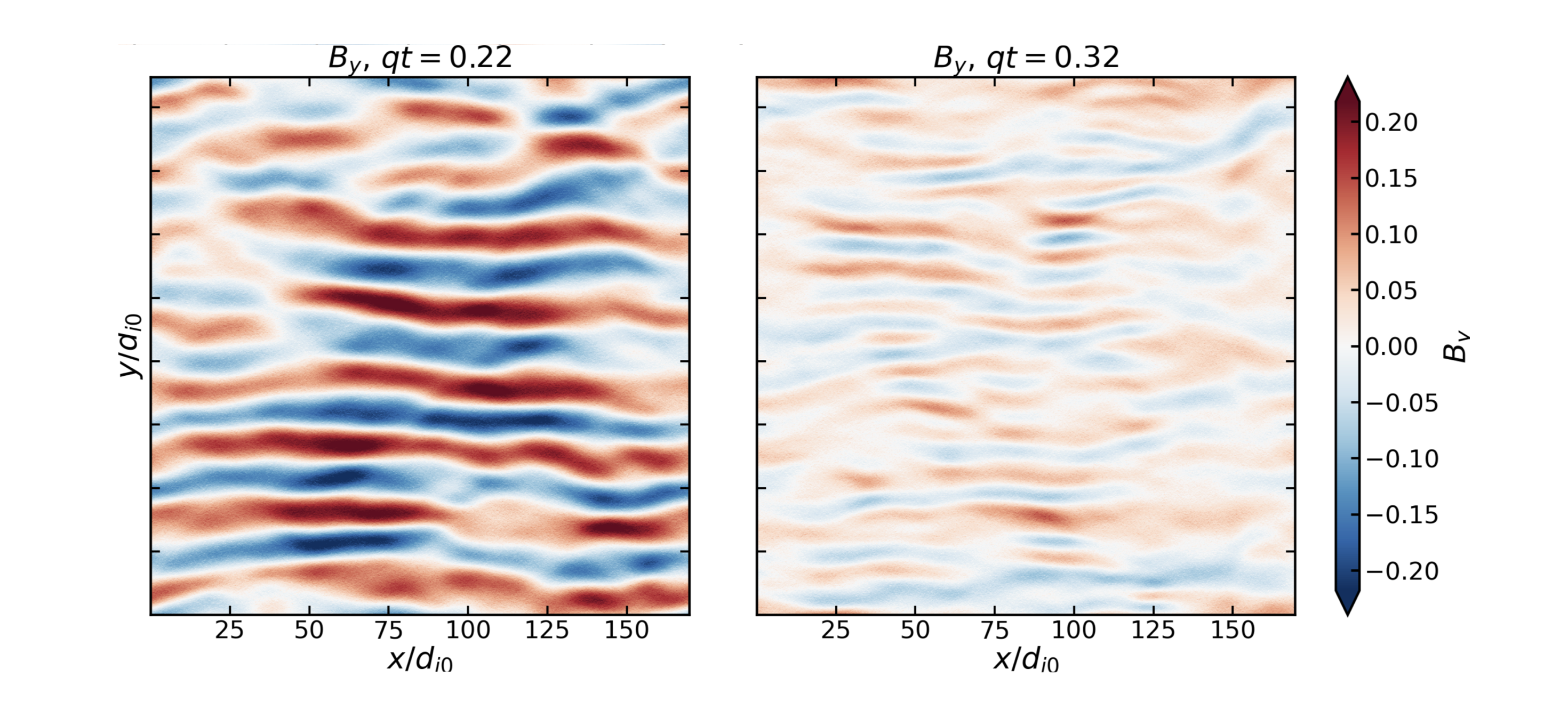
In this work, we study driven collisionless reconnection in merging force-free flux tubes using particle-in-cell simulations of strongly magnetized pair plasmas. The main goal is to understand how reconnection sets in during flux-tube compression, how the nonlinear merging phase develops, and how these dynamics change from 2D to 3D. The 2025 ApJ paper focuses on onset, thinning, and plasmoid formation in 2D, while the 2026 preprint extends the problem to fully 3D kinetic simulations. Driven reconnection in merging flux tubes. The figure summarizes the evolution from current-sheet formation to fast nonlinear merging and particle energization in kinetic simulations of magnetized pair plasmas.These simulations show that the current sheet forms through external driving and thins until reconnection begins. In 2D, plasmoid formation appears once the sheet becomes sufficiently elongated, while the subsequent fast-merging phase becomes largely insensitive to the initial driving speed. In 3D, the same system develops a richer current-sheet structure and patchier reconnection geometry, while preserving the overall picture of delayed onset followed by rapid magnetic-energy release.This work provides a kinetic framework for reconnection-driven energy release in compact-object environments and other strongly magnetized astrophysical plasmas.